

 Contact Us
Some Nvidia employees are reportedly asking for Jensen Huang's return following his resignation as chief executive. But employee reaction and the company's formal leadership position are different stories. NVIDIA has announced Colette Kress as interim CEO while its board searches for a permanent successor.
The key to understanding the Nvidia CEO transition is to separate reported staff sentiment from the decisions recorded by the company and the U.S. Securities and Exchange Commission. The official sources reviewed on do not announce Huang's reinstatement.
Lead image: AI-assisted editorial composite based on a historical Jensen Huang photograph by Raysonho / Open Grid Scheduler, available under CC0, with a NVIDIA newsroom logo reference. The portrait, background and layout have been edited; this is not a photograph of the 2026 events. NVIDIA and its logo are trademarks of NVIDIA Corporation; no affiliation or endorsement is implied.

For readers following the AI industry, this is both a leadership story and a question of business continuity. A change at the top does not automatically alter a software platform, cancel an order or settle an investigation. It does create a need to identify who is responsible now, which commitments remain in place and what further information is actually available.
What the employee-support report establishes
In a 12 November report, WIRED said an internal post, submitted before Huang resigned, had attracted more than 1,600 comments, most supporting his return. The publication said it reviewed internal correspondence.
That figure describes comments, not necessarily individual employees. Without a verified count of unique participants, an authenticated signatory list or a representative vote, it cannot establish how the workforce as a whole feels. The report is evidence of employee reaction; it is not an announcement of a board decision.
The same distinction applies to the word petition. Readers should ask what the underlying record actually contains, who examined it and whether its participants have been independently verified. A headline about support for a former executive does not, by itself, establish that the company is preparing to bring that executive back.
This limitation cuts both ways. An active discussion should not be dismissed simply because it is not a formal ballot. Equally, the views of people who choose to participate cannot automatically be assigned to those who do not. Silence may have many explanations; it is not a reliable vote for either side.
There are also different questions within employee feedback. Wanting a clearer explanation of a decision, questioning the process used to reach it and wanting a particular person appointed are not identical positions. Coverage that combines them into one sweeping demand can lose the distinction between a request for information and a proposed outcome.
For any stronger claim of collective action, the useful evidence would include the actual document, its date, a clear account of who could participate and a reliable method of authenticating participation. This article does not treat an unverified mass letter or a purported signatory count as established evidence.
Investor calls are a separate development
Support for considering Huang's return is not limited to the reported internal discussion. In a 14 November report, The Economic Times described a letter from Altimeter Capital's Brad Gerstner and Atreides Management's Gavin Baker asking the board to take time over succession and consider Huang among its options. The investors also expressed confidence in Kress and the interim team.
That is an attributed account of shareholders advocating a process, not a statement that the board has adopted their position. It should not be merged with employee comments into a single verified workforce petition or presented as proof that a return has been agreed.

What NVIDIA and the SEC filing confirm
NVIDIA's Form 8-K records that the board accepted Huang's resignation as president, chief executive officer and a director on 11 November 2026, effective immediately. It also records the appointments of Colette M. Kress as interim CEO and Harvey C. Jones as board chair.
The company publicly announced the changes in its 12 November CEO-transition release. The two dates refer to different stages of the same transition: the board action and the public announcement.
NVIDIA says its permanent CEO search will consider both internal and external candidates. The release does not name a permanent successor or set out a reinstatement plan. Claims about a possible future appointment should therefore be kept separate from the leadership arrangement the company has actually announced.
Why the Form 8-K matters
The SEC's guide to reading Form 8-K explains that companies use these current reports to disclose significant events promptly, rather than waiting for their next quarterly or annual report. Item 5.02 covers executive departures and appointments, among other matters. That makes it a particularly relevant starting point for this story.
An 8-K is not necessarily a complete narrative of everything discussed inside a company. Here, it provides a concise record of changes in office. Readers should neither overlook those changes because a social post says otherwise nor assume that a short filing answers every question about motives, deliberations or future decisions.
It also helps to keep job titles separate. President, chief executive officer and director are distinct positions, even when one person holds all three. The filing expressly addresses Huang's departure from each. A claim that he retains or has regained a formal role needs its own current evidence; a reference to his historical contribution is not enough.
Who is leading Nvidia now?
NVIDIA's current executive biography identifies Colette Kress as interim CEO, executive vice president and chief financial officer. She joined NVIDIA in September 2013 after finance roles at technology companies including Cisco and Microsoft.
Her appointment is interim, not a confirmed permanent replacement for Jensen Huang. Kress continues to hold the CFO role during the search, according to the company's announcement.
Her executive biography gives some context for that background. Before NVIDIA, she was CFO of Cisco's Business Technology and Operations Finance organisation. She also spent 13 years at Microsoft, including four as CFO of its Server and Tools division. These are documented career facts, not a prediction about how she will lead NVIDIA or whether she will be selected permanently.
The distinction between current leadership and the eventual succession decision is important. It is possible to know who is serving as interim CEO without knowing who will win a permanent search. Conversely, the existence of a search does not mean that the interim appointment is merely ceremonial or that the company has announced a leadership vacuum.
In the transition release, the board said it expected operations, customer commitments and the product roadmap to continue without interruption. That is management's stated expectation, not independent proof that every delivery or business relationship will be unaffected.
For customers and developers, the practical questions concern the services and products they actually use: whether support contacts change, whether published schedules are updated and whether existing commitments are met. Those questions are better answered by specific company notices and observed delivery than by predictions about an executive's return.
The investigation and resignation timeline
In his 8 November message to employees, published by NVIDIA, Huang acknowledged marital infidelity, apologised and said he would cooperate with the board's independent investigation. His message also referred to national-security concerns raised in news reports. An acknowledgement of personal conduct is not a finding that every allegation in outside reporting is true.
On 10 November, the independent board members said they had retained former acting U.S. Attorney Joon H. Kim and Wachtell, Lipton, Rosen & Katz to conduct the investigation. That statement announced an investigative process, not its conclusions.
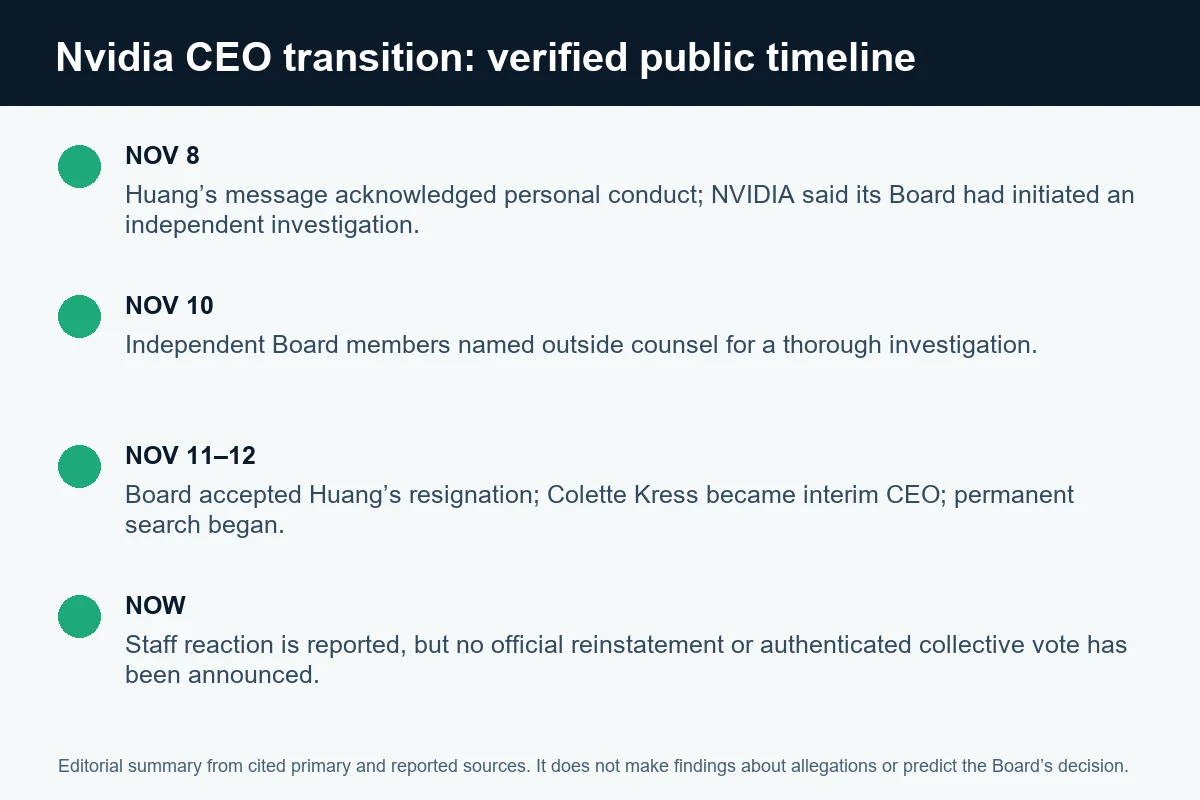
- 8 November: NVIDIA published Huang's apology and his commitment to cooperate with the investigation.
- 10 November: Independent directors identified the outside lawyer and firm conducting the inquiry.
- 11 November: The board accepted Huang's resignation and appointed Kress interim CEO, according to the SEC filing.
- 12 November: NVIDIA publicly announced the transition and permanent CEO search.
The transition announcement does not provide a detailed explanation for the resignation or publish investigative findings. The available official record should not be used to infer a completed inquiry, a proven accusation or an inevitable outcome.
The sequence establishes what was announced and when. It does not establish everything that happened in private between those announcements. In particular, the date of an apology is not necessarily the date of the conduct it addresses, and the date an investigator is named is not a report-completion date. A responsible timeline labels these events precisely rather than using proximity as proof of causation.
Why the board and management have different roles
NVIDIA's governance page describes the board as overseeing management's performance on behalf of shareholders. The corporate-governance policies linked from that page, effective 3 March 2025, distinguish management's operational responsibilities from the board's oversight of management and risk.
Those policies assign management responsibility for operating the company, preparing reports, informing the board and identifying and managing risks. They describe board responsibilities that include monitoring management and overseeing risk management. This published framework helps explain why an executive appointment, an operational update and an investigation statement answer different questions.
The appointment of a board chair should likewise not be confused with the appointment of a CEO. In the announced transition, Jones holds the chair role and Kress the interim executive role. Calling both changes a single replacement for Huang would obscure the actual structure.
Employee feedback can be significant information in that structure without becoming a binding instruction. The relevant distinction is between hearing a constituency and transferring a formal decision to it. An internal discussion may raise questions that deserve a response; it does not, by itself, tell an outside reader how directors assessed all the information available to them.
Nor does the governance framework settle whether any particular decision was right. Knowing which body has a responsibility is different from knowing how well that responsibility was exercised. Assessing the latter requires evidence about the decision and its consequences, not simply a preference for one executive or a reading of a policy heading.
What Nvidia's own succession-risk disclosures say
Leadership continuity was a disclosed business issue before this week's transition. In its fiscal 2026 Form 10-K, NVIDIA said it depended heavily on its longstanding executive team. It warned that ineffective succession planning, knowledge transfer or transitions involving executives and key employees could impede strategy, execution and long-term success.
The same annual report recorded approximately 42,000 employees across 38 countries at fiscal year-end on 25 January 2026. That is a dated workforce baseline, not a verified headcount for November. It illustrates why the activity in one internal discussion cannot be equated with a census of the organisation.
A risk disclosure is a statement about what could go wrong, not evidence that the risk has already materialised. It supports taking succession seriously; it does not establish that NVIDIA has lost crucial knowledge, suffered a departure of technical staff or become unable to execute its roadmap.
The practical issue is therefore the transfer of responsibilities and information, not merely the transfer of a title. Readers can look for clear reporting lines, accountable communication and specific evidence that decisions continue to be made. Those are analytical questions for following the transition, not claims that the company has already failed or passed a continuity test.
Why Nvidia's AI platform matters beyond its chief executive
The technology context extends beyond individual chips. NVIDIA's developer-platform directory includes the CUDA Toolkit for GPU-accelerated applications, CUDA-X libraries and Nsight tools for development, debugging and profiling. These are concrete parts of the ecosystem used to build and maintain software on accelerated-computing hardware.
That helps frame the questions for developers. A leadership headline is not itself a software-release note. It does not identify a new compatibility requirement, withdraw a programming interface or tell a team to change its deployment. Any such change needs to be checked against the relevant technical documentation and product notice.
For example, a team maintaining an application would need to know the supported versions of its toolkit and drivers, the hardware it runs on and the support commitments relevant to that configuration. The name of the CEO does not supply those details. The leadership story may affect longer-term expectations, while the immediate engineering decision still depends on the actual system and its documented requirements.
The opposite assumption would be equally weak: the existence of established platforms cannot guarantee that every future investment, release or commercial priority will remain unchanged. Present technical capabilities and future corporate choices are related but not identical. Keeping them separate makes it possible to follow the business story without turning speculation into technical advice.
Questions for customers, developers and employees
Different groups have different information needs during the Nvidia leadership transition. A useful update for one audience may not answer the questions of another. The following are practical ways to identify a relevant development, not evidence that any of the listed problems has occurred.
Customers and infrastructure partners
A customer with an existing deployment or order can distinguish general reassurance from an update to its own commitment. Has the company or its authorised partner changed a delivery date, an escalation contact or a service arrangement? Is the message about an existing agreement or a new proposal? Specific answers are more useful than assuming that every commercial relationship is either secure or disrupted.
Developers and technical teams
For developers, the relevant record is the platform documentation, release notes and support information for the systems they use. An actual change in supported software, access or product availability would be actionable information. A prediction about a future CEO's preferences is not a substitute for that record.
Employees and applicants
For staff and prospective hires, questions about reporting lines, organisational priorities and how leadership will communicate are different from questions about who should be CEO. A clear answer to an operational question need not resolve a personal view of the succession decision. Outside coverage should avoid treating every workplace concern as proof of a particular political camp inside the company.
Readers following the business
For the wider audience, the most informative developments will be those that change the documented picture: an appointment, a substantive investigation statement or a specific change in business commitments. The volume of commentary is not a measure of how much new information has emerged.
What to watch next in the Nvidia leadership transition
NVIDIA's transition release says its third-quarter fiscal 2027 results remain scheduled for 17 November, with an earnings call to follow. That is a confirmed communication date, not a promise that the board will resolve the CEO search or release investigation findings at the event.
The company's original earnings-call announcement gives more detail: results are due at approximately 1:20 p.m. Pacific Time and the call at 2 p.m. The call concerns the quarter ended 25 October. The company said a listen-only webcast would be available through its investor website, with prepared remarks followed by questions from financial analysts and institutional investors.
Those dates create an important limit on interpretation. The reporting period ended before the November leadership announcements. Reported quarterly performance therefore should not be presented as a measured record of several weeks under the interim CEO. Any discussion of later events, current conditions or future expectations needs to be identified separately.
Three kinds of update would materially change the picture:
- A formal leadership announcement: Look for a dated company release or regulatory filing naming a permanent CEO or changing an executive's role.
- A substantive investigation update: Check whether a statement announces findings, describes ongoing work or simply repeats that the inquiry exists.
- Specific operational disclosures: Distinguish a general continuity message from a change to guidance, a product schedule or a customer commitment.
Until then, the most useful distinction remains between what employees may want, what reporters have established and what the board has formally decided. Each can matter without being interchangeable.
When reading the next update, check whether it describes a completed action, an expectation or a process still under way. A completed appointment changes the leadership record. An expectation of continuity is a forward-looking statement. A search or inquiry can be active without having reached a result. These distinctions help readers recognise a real development rather than a new headline attached to unchanged facts.
Key questions answered
Has Jensen Huang returned as Nvidia CEO?
The official sources reviewed on 15 November identify Kress as interim CEO. They do not announce Huang's return.
Is Colette Kress the permanent CEO?
Not in the announced arrangement. Her appointment is interim while the board conducts a permanent search.
Does the resignation establish the investigation's outcome?
No. A leadership change and an investigation are distinct developments. The cited transition announcement does not publish investigative findings.
Why are both 11 and 12 November mentioned?
The SEC filing records the board's acceptance of the resignation on 11 November. NVIDIA's public announcement is dated 12 November. Reporting both dates accurately is preferable to treating the public release date as the only relevant timestamp.
Does the internal discussion establish a workforce majority?
No representative employee vote is established by the evidence described here. A comment total cannot establish a majority without reliable information about unique participants, the eligible population and how responses were collected.
Is there a confirmed date for a permanent appointment?
The cited CEO-transition release does not provide one. The scheduled earnings event should not be presented as a succession deadline unless the company explicitly says so.
Sources and reporting scope
This article is based on public documents and attributed reporting reviewed on 15 November 2026. Web Solution Centre has not independently inspected NVIDIA's internal correspondence. The leadership status is time-sensitive; readers should check NVIDIA's dated releases and filings for later developments.
- SEC: NVIDIA Form 8-K, signed 12 November 2026
- NVIDIA: CEO transition announcement, 12 November 2026
- NVIDIA: Colette Kress executive biography
- NVIDIA: Huang's message to employees, 8 November 2026
- NVIDIA: statement from independent directors, 10 November 2026
- WIRED: employee-reaction report, 12 November 2026
- The Economic Times: investor letter on the CEO search, 14 November 2026
- SEC Investor.gov: how to read Form 8-K
- NVIDIA: governance documents and linked board policies
- SEC: NVIDIA fiscal 2026 Form 10-K
- NVIDIA Developer: platforms and tools
- NVIDIA: third-quarter results call announcement, 28 October 2026