

 Contact Us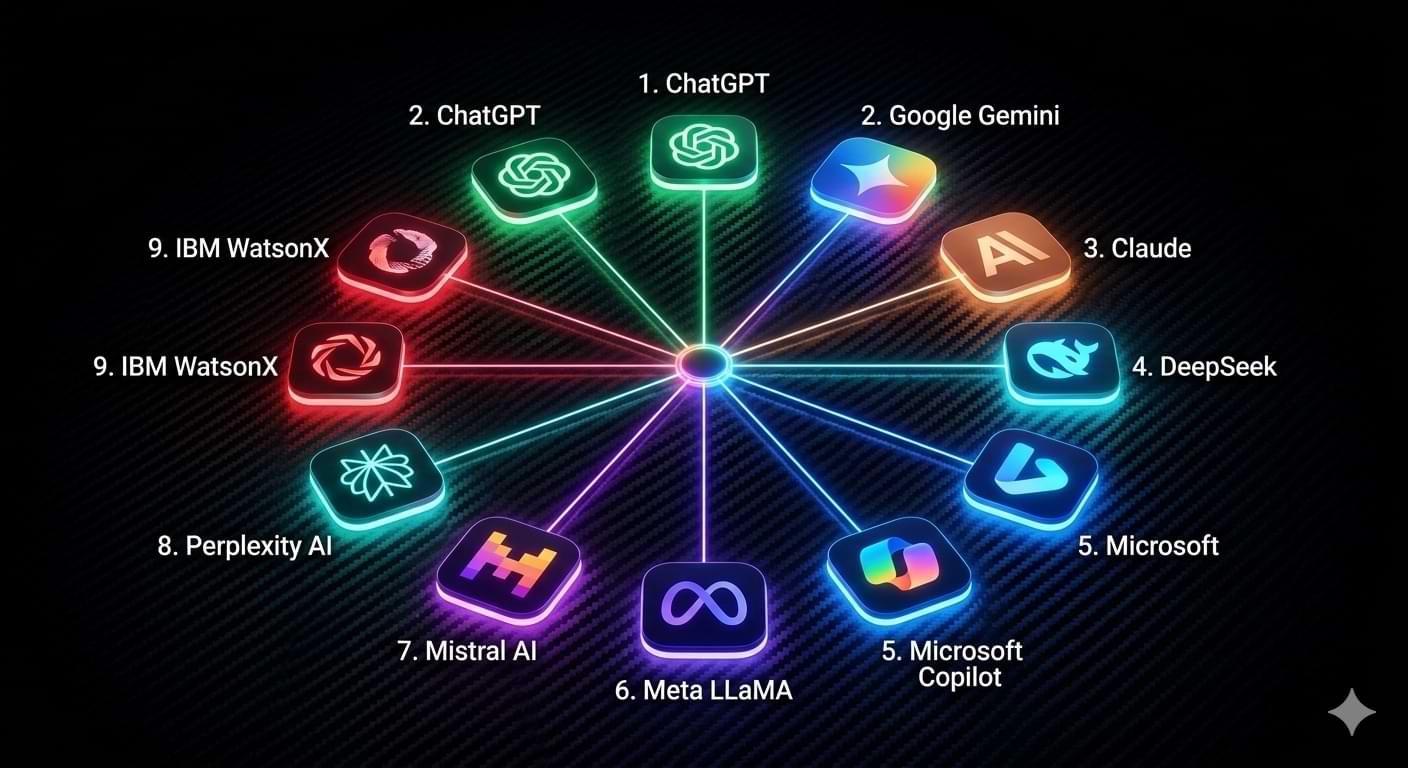
AI Tool Comparison: The Major Players in 2026
To help you make sense of the AI landscape, here's a straightforward comparison of the leading AI platforms that businesses are actually using right now. This will help you evaluate which tools might fit your workflow, your budget, and your business goals.
| AI Platform | Best For | Open Source? | Pricing Model | Strengths | Limitations | Website |
|---|---|---|---|---|---|---|
| ChatGPT (OpenAI GPT-4o) | Content creation, customer support, general tasks | No | Free tier + $20/mo Pro | Best-in-class reasoning, huge plugin ecosystem | Expensive at scale; data privacy concerns | Visit |
| Google Gemini 2.0 | Multimodal tasks, search integration, enterprise | Partially | Free + $19.99/mo Advanced | Real-time web access, video/audio understanding | Inconsistent performance across tasks | Visit |
| Meta LLaMA 3.3 | Self-hosted deployments, fine-tuning | Yes | Free (self-host) | No licensing cost, fully customisable | Requires technical expertise to deploy | Visit |
| DeepSeek R1 | Reasoning, coding, research tasks | Yes | Free (API available) | Exceptional reasoning at low cost | Data stored on Chinese servers — privacy concern | Visit |
| Claude (Anthropic) | Long documents, nuanced writing, analysis | No | Free + $18/mo Pro | Best for long-form content, strong safety alignment | Limited integrations vs. OpenAI | Visit |
| Microsoft Copilot | Office 365 integration, enterprise workflows | No | Included in M365 or $30/user/mo | Deep Office integration, Teams compatibility | Costly for small teams; requires M365 | Visit |
| Mistral (Mixtral 8x22B) | Multilingual tasks, efficient inference | Yes | Free (self-host) + API | Fast, multilingual, European data sovereignty | Smaller ecosystem than OpenAI | Visit |
| Perplexity AI | AI-powered search and research | No | Free + $20/mo Pro | Real-time cited answers, excellent for research | Not suited for creative or generative tasks | Visit |
| IBM WatsonX | Enterprise AI governance and workflows | Partially | Custom enterprise pricing | Industry-grade compliance and trust features | Complex setup; not suited for small businesses | Visit |
Choosing the right AI tool for your business isn't about picking the most popular one — it's about finding the right fit for your specific use case, budget, and data privacy requirements. If you're not sure where to start, get in touch with our team and we'll walk you through the options that make the most sense for your business.
There's a word being repeated in every boardroom, every tech podcast, and every forward-thinking business strategy session right now — and it's not "ChatGPT." It's not "machine learning" either. The word is agents. AI agents. And if you haven't started paying serious attention to what they are and what they're already doing inside competing businesses, this is your wake-up call.
AI Agents in 2026: The Silent Workforce Revolution Your Business Can't Afford to Ignore
We're at a genuinely historic inflection point. Artificial intelligence has spent the last few years teaching itself to answer questions brilliantly. Now it's teaching itself to take action. The leap from "AI that talks" to "AI that does" is the single most consequential shift in the history of the technology — and it's happening right now, at full speed, whether your business is ready or not. At Web Solution Centre, we believe every business owner and digital decision-maker needs to understand this shift deeply, because it will determine who leads their market and who gets left behind over the next three to five years.
What Exactly Is an AI Agent? (And Why the Definition Matters)
Let's start with clarity, because this term gets misused constantly. An AI agent is not just a chatbot with a better vocabulary. It's not a fancy autocomplete tool. An AI agent is a software system that can perceive its environment, make decisions, take actions, and pursue goals — with a meaningful degree of independence.
Think of the difference this way. A traditional AI assistant waits for you to ask it something and then responds. An AI agent, on the other hand, can be given a goal — "generate ten qualified sales leads from LinkedIn this week and book them into our CRM" — and then go figure out how to accomplish it. It browses the web, reads profiles, sends connection requests, drafts personalised messages, evaluates responses, and updates your CRM — all without you manually directing each step.
- AI agents operate with autonomy — they decide how to achieve a goal, not just what to say in response to a prompt
- They can use tools: browsers, code editors, databases, APIs, email clients, calendars, and more
- They can chain multiple steps together in complex sequences, adapting when something doesn't work as planned
- They can collaborate with other agents — a network of specialised AI workers completing different parts of a workflow simultaneously
- The market for agentic AI is projected to grow from $8.6 billion in 2025 to $263 billion by 2035 — a 40% compound annual growth rate
This isn't science fiction. This is what enterprise teams at companies like IBM, Microsoft, Google, and Salesforce are actively deploying today. And thanks to the democratisation of AI technology driven by open-source models, these capabilities are now within reach for businesses of every size.
The Numbers Behind the Agentic AI Revolution
Before we go deeper into how agents work and what they mean for your business, it's worth grounding the conversation in data. Because the numbers here are extraordinary — and they tell a very clear story about where resources, talent, and competitive advantage are flowing.
| Metric | Figure | Source / Context |
|---|---|---|
| Projected AI agent market size by 2035 | $263 billion | Research Nester — 40% annual growth rate from 2025 |
| Business leaders using generative AI regularly | 85% | BCG AI at Work 2025 survey |
| Customer service cost reduction from AI automation | Up to 25% | Industry average from AI chatbot and agent deployments |
| Google searches ending without a click in 2026 | 68–72% | AI Overviews now handle most informational queries |
| AI Overviews appearing on informational queries | 64.7% | Measured across US search data, early 2026 |
| Reduction in development time using AI coding agents | 60–70% | Developer productivity studies, 2025–2026 |
| Frontline employees regularly using AI tools | 51% | BCG AI at Work 2025 survey — lagging behind leadership adoption |
| Samsung Gemini AI device target for 2026 | 800 million units | Samsung CES 2026 announcement |
The gap between organisations actively deploying AI agents and those still "exploring" is widening by the quarter. The companies that implement agentic systems today are compounding advantages in speed, efficiency, and customer experience that become progressively harder for slower movers to close. This is the window. And it's open right now.
How AI Agents Actually Work: A Plain-Language Breakdown
You don't need to be a computer scientist to understand how agents function — and understanding the mechanics helps you make better decisions about where to deploy them in your own business. Here's how a typical AI agent operates in practice.
The Four Core Capabilities of an AI Agent
1. Perception: The agent takes in information from its environment. This might be a user prompt, a web page, a database entry, an email, a calendar, a file — anything it has been given access to read.
2. Reasoning: Using a large language model as its cognitive engine, the agent processes what it's perceived, plans a series of steps to achieve its goal, and decides which tools or actions to use next. This is where modern reasoning models — like those from OpenAI's o-series, Google's Gemini 2.0, and DeepSeek R1 — have made the biggest leaps forward in 2025 and 2026.
3. Action: The agent executes steps — running code, browsing URLs, sending API calls, writing files, or triggering other systems. It doesn't just describe what should happen; it actually does it.
4. Memory and Learning: Advanced agents maintain context across sessions. They remember previous interactions, outcomes of past decisions, and user preferences. This is what separates a sophisticated AI agent from a one-shot chatbot.
Single Agents vs. Multi-Agent Systems
One of the most exciting and commercially significant developments in 2026 is the shift from single agents to multi-agent systems — networks of specialised AI workers that collaborate on complex tasks.
- A single agent might handle your customer support inbox — reading messages, classifying them, drafting replies, escalating when needed
- A multi-agent system might run your entire marketing operation — one agent researching trends, another drafting content, a third scheduling and posting, a fourth analysing performance and feeding insights back to the first
- IBM's research confirms: "We've moved past the era of single-purpose agents. In 2026, the competition won't be on AI models — but on the systems."
- Microsoft's Aparna Chennapragada describes a near-future workplace where a three-person team can run a global campaign in days using AI agents for data, content, and personalisation while humans steer strategy
This is the new competitive landscape. Not which AI model you use — but how well you've designed and orchestrated your AI systems. If your website and digital infrastructure aren't built to integrate with these kinds of systems, you're working with one hand tied behind your back. Our team at Web Solution Centre builds digital foundations specifically designed to accommodate this kind of intelligent integration.
Where AI Agents Are Making the Biggest Impact Right Now
Let's move from theory to reality. Here are the specific business functions where AI agents are delivering measurable results in 2026 — functions that almost certainly overlap with what your business does every day.
Customer Service and Support
This is where AI agents have been deployed longest and are most mature. Modern AI support agents don't just answer FAQs — they diagnose problems, access order systems, issue refunds, book callbacks, and escalate to human agents only when genuinely necessary. The results in deployed systems are remarkable.
- Businesses using AI agent-based support report handling 60–80% of inbound queries automatically without human involvement
- Customer satisfaction scores often improve because wait times drop dramatically and availability extends to 24/7
- Agent-assist tools (where AI works alongside a human agent) reduce handling time by 25–40%
- Multilingual support — once requiring expensive specialist hiring — is now delivered instantly in any language
If your website currently has a static contact form and customers wait 24–48 hours for a reply, you are losing business to competitors who respond in 30 seconds, any time of day. This is not hyperbole — it is the measurable reality of consumer expectations in 2026.
Sales and Lead Generation
AI sales agents are perhaps the most commercially exciting application right now. These systems can identify potential customers, research their businesses and pain points, personalise outreach, follow up automatically at optimal times, and hand off warm, qualified leads to human salespeople when the timing is right.
- Outbound prospecting agents can research, personalise, and send hundreds of targeted messages per day — tasks that would consume a full-time human team
- AI lead scoring analyses engagement signals in real-time and prioritises the leads most likely to convert — saving sales teams significant time on dead ends
- Conversational AI on landing pages and product pages can qualify visitors and capture contact details through natural dialogue rather than static forms
- CRM integration means every interaction is logged, tagged, and used to improve future outreach automatically
Content Creation and Marketing Operations
Content marketing has always been resource-intensive. Ideation, research, writing, editing, SEO optimisation, scheduling, performance analysis — a full content operation traditionally required a significant team. AI agents are compressing this dramatically.
- Research agents scan industry sources, competitor content, and trending topics and deliver structured briefs in minutes
- Writing agents produce first drafts that humans refine — cutting production time by 50–70% for most content types
- SEO agents analyse on-page factors, suggest improvements, and track ranking changes with continuous monitoring
- Social media agents can schedule, post, monitor engagement, and respond to comments across platforms simultaneously
- A/B testing agents continuously experiment with headlines, CTAs, and imagery and implement winning variations without manual setup
For businesses working with us at Web Solution Centre, this translates into content-driven websites that stay fresh, current, and competitively optimised without requiring your team to spend half their time on production work. See the kind of digital experiences this makes possible by browsing our project portfolio.
Web Development and IT Operations
AI coding agents — tools like GitHub Copilot, Cursor, and Devin by Cognition — have changed what's possible in a development sprint. They write code, review pull requests, catch security vulnerabilities, suggest architectural improvements, and run automated testing. The developer's role is shifting from line-by-line coding to higher-level design, oversight, and quality control.
- MIT Technology Review named AI coding tools among its 10 Breakthrough Technologies of 2026 — a landmark recognition
- Development timelines that once took weeks can compress to days with agents handling boilerplate and repetitive coding tasks
- IT operations agents monitor infrastructure in real-time, detect anomalies, and respond to potential outages before they affect users
- Security agents scan continuously for vulnerabilities, flagging risks long before a human reviewer would catch them
Finance, HR, and Internal Operations
Inside organisations, AI agents are quietly transforming the back-office operations that consume enormous amounts of human time without directly generating revenue.
- Finance agents automate invoice processing, expense reconciliation, and financial report generation with near-zero error rates
- HR agents handle initial candidate screening, schedule interviews, send automated updates, and onboard new hires through guided digital workflows
- Procurement agents monitor supplier performance, flag contract renewals, and generate purchase orders within approved parameters
- Compliance agents continuously monitor business activities against regulatory requirements and generate audit-ready documentation
AI Agents vs. Traditional Automation: What's Actually Different?
Many business owners hear "AI agent" and think: "We already use automation tools. How is this different?" It's a fair question — and the answer matters a great deal.
| Capability | Traditional Automation (RPA, workflows) | AI Agents |
|---|---|---|
| Task handling | Pre-defined rules only; breaks if anything changes | Adapts to new situations and unexpected inputs |
| Decision-making | Binary: if X then Y | Contextual reasoning with nuance and prioritisation |
| Language and communication | Cannot read or write natural language effectively | Understands and generates fluent, contextual language |
| Setup and maintenance | Requires constant manual updating as processes change | Adapts to process changes through re-prompting or retraining |
| Multi-step complexity | Linear only; cannot handle branching logic well | Plans and executes complex multi-step workflows autonomously |
| Learning over time | Static; must be manually updated | Improves through feedback and memory across sessions |
| Integration with AI models | Limited or none | Built on top of LLMs with direct AI reasoning capability |
| Use cases | Repetitive, rule-based data tasks | Creative, analytical, conversational, and operational tasks |
| Error recovery | Fails and stops; requires human intervention | Identifies errors, attempts alternatives, flags when stuck |
The gap isn't marginal — it's categorical. Traditional automation is like a very precise but rigid machine. An AI agent is like a very capable (if imperfect) junior colleague who can figure things out, adapt, and get creative when circumstances change. Both have their place. But for the complex, language-heavy, decision-rich tasks that define most modern business operations, agents win decisively.
The Real Risks of AI Agents (And How to Navigate Them)
We'd be doing you a disservice if we only talked about the upside. AI agents are powerful — and like all powerful tools, they come with real risks that require thoughtful management. Being honest about these is what separates responsible AI adoption from reckless experimentation.
Hallucination and Errors
AI agents can still make mistakes — sometimes confidently wrong ones. In a chatbot, a wrong answer is inconvenient. In an autonomous agent making business decisions, errors can have real consequences. This is why human oversight and escalation paths remain essential, especially for high-stakes decisions involving money, legal obligations, or customer commitments.
Security and Prompt Injection
One of the most serious risks identified by cybersecurity researchers in 2026 is prompt injection — where malicious content embedded in a webpage or document tricks an AI agent into taking harmful actions. Microsoft's security team has been vocal about this: every AI agent needs the same security protections as a human employee, including clear identity, access limits, and monitoring.
- Give every agent a specific, limited scope — don't let one agent have access to everything
- Log all agent actions so unexpected behaviour can be detected and traced
- Implement human approval gates for actions with significant financial or reputational consequences
- Keep AI agents updated as security vulnerabilities are discovered and patched
Data Privacy and Compliance
AI agents process enormous amounts of data — customer conversations, financial records, internal communications. In the EU, the AI Act places strict requirements on high-impact AI systems around transparency, data handling, and human oversight. In the UK, the ICO is actively investigating AI platforms. Any business deploying agents needs a clear data governance policy and ideally a legal review of their implementation.
Over-Reliance and Skill Erosion
Harvard Business School researchers are flagging what they call "second-order effects" — what happens to the humans in an organisation when AI agents handle more and more of the work. There's a real risk that employees lose valuable skills, that work becomes less meaningful, and that critical human judgement atrophies. The organisations navigating this best are those treating AI deployment as a redesign of work — not just a cost-cutting exercise.
How to Choose the Right AI Agent Platform for Your Business
The agent ecosystem in 2026 is diverse and fast-moving. Here's a practical guide to the most widely adopted agent platforms, to help you find the right starting point.
| Platform | Best For | Key Strengths | Ideal Business Size | Link |
|---|---|---|---|---|
| OpenAI Assistants API | Custom AI assistants and agents | Most powerful reasoning; huge developer ecosystem | SME to Enterprise | OpenAI Platform |
| Microsoft Copilot Studio | Enterprise workflow agents | Deep Office 365 integration; no-code agent builder | Mid-market to Enterprise | Copilot Studio |
| Google Vertex AI Agent Builder | Search and conversational agents | Enterprise-grade, deep Google Search integration | Mid-market to Enterprise | Google Vertex |
| Zapier AI (with agents) | Workflow automation with AI | No-code; connects 7,000+ apps; fast to deploy | Small Business to SME | Zapier AI |
| LangChain / LangGraph | Custom agent development | Open source; maximum flexibility; developer-first | Tech-savvy SME to Enterprise | LangChain |
| CrewAI | Multi-agent orchestration | Build teams of AI agents for complex workflows | SME to Enterprise | CrewAI |
| n8n | Open-source workflow agents | Self-hostable; powerful; European data sovereignty | Small Business to Mid-market | n8n |
Choosing a platform is only the beginning. The real work — and the real value — lies in designing the right agent workflows for your specific business context, training them on your data, integrating them with your existing systems, and monitoring them as they run. This is where the expertise of a skilled digital partner becomes genuinely valuable. If you'd like to explore what AI agent integration could look like for your specific business, start a conversation with our team at Web Solution Centre.
AI Agents and Your Website: The Direct Connection
Here's where all of this becomes immediately practical for every business with a website — which in 2026 means every business, full stop. Your website is not just a brochure. In the era of AI agents, your website is a live, dynamic interface between your business and the digital systems that potential customers, search engines, and AI platforms interact with constantly.
AI Agents Are Visiting Your Website Right Now
This is something most business owners haven't fully absorbed yet: AI agents from search engines, competitor research tools, price comparison platforms, and AI assistants are already crawling and reading your website autonomously. When a potential customer asks ChatGPT or Perplexity "who are the best web development companies in my area?" — AI systems go read websites, evaluate them, and compile recommendations. If your website doesn't clearly communicate what you do, who you serve, and why you're excellent at it, AI systems will simply recommend your competitors instead.
- Structured data and schema markup help AI systems correctly categorise and cite your business
- Clear, authoritative content written in plain language is more likely to be cited in AI Overviews and chat responses
- Fast-loading, technically sound websites are prioritised by both traditional search and AI-powered discovery
- Regular content updates signal to AI systems that your business is active, current, and trustworthy
Deploying Your Own AI Agents Through Your Website
Beyond being readable by external AI systems, your website can — and in 2026 increasingly should — deploy its own AI agents to serve visitors. The most immediate opportunity is an intelligent conversational agent that goes far beyond a traditional chatbot.
- An AI agent trained on your services, pricing, case studies, and FAQs can handle the full qualification conversation for inbound leads
- It can ask the right questions, understand the prospect's situation, recommend the appropriate service, and book a discovery call — all without human involvement
- Integration with your CRM means every conversation enriches your customer data automatically
- A well-built agent learns over time which conversation paths lead to conversions and optimises accordingly
We've seen this kind of implementation significantly change the economics of lead generation for clients — reducing the cost per qualified lead while improving the quality of the sales conversations that human team members actually have. If you'd like to see what a well-built digital platform looks like in practice, explore the work we've done for our clients.
Getting Started: A Practical AI Agent Roadmap for 2026
You don't have to do everything at once. In fact, the businesses making the smoothest transitions to AI-augmented operations are the ones taking deliberate, sequenced steps rather than trying to transform everything simultaneously. Here's a phased approach that we've seen work well.
Phase 1 — Foundation (Month 1–2): Audit and Identify
- Audit your website's technical health, content quality, and AI readiness using tools like Google PageSpeed Insights and Google Search Console
- Map your most time-consuming, repetitive business processes — these are your highest-value agent opportunities
- Identify the two or three customer touchpoints that create the most friction and take the most staff time
- Assess your current tech stack and identify where AI agent integrations would be most straightforward
Phase 2 — Quick Wins (Month 2–4): Deploy Your First Agents
- Deploy an intelligent website agent for lead qualification and FAQs — this typically delivers the fastest, most measurable ROI
- Implement an AI-assisted content production workflow for your blog and social media — use AI for research and drafting, humans for editing and brand voice
- Set up automated email nurture sequences triggered by on-site behaviour
- Integrate AI-powered analytics to surface actionable insights from your existing data
Phase 3 — Scaling (Month 4–12): Build Your Agent Infrastructure
- Connect agents across your sales, marketing, and customer service functions so they share context and data
- Implement multi-agent workflows for your most complex operational challenges
- Establish monitoring, logging, and human oversight systems for all deployed agents
- Train your team to work with AI agents effectively — not to compete with them or ignore them
- Continuously measure, refine, and expand your agent capabilities based on performance data
The Human-AI Partnership: What the Best Businesses Are Actually Doing
Every credible voice in AI research — from Microsoft's Aparna Chennapragada to MIT Sloan Management Review to Harvard Business School faculty — is saying the same thing in different ways: the future of work is human-AI collaboration, not human replacement by AI.
The businesses getting this right are not the ones automating the most aggressively. They're the ones thinking clearly about which tasks AI agents are genuinely better at — pattern recognition, data processing, availability, speed, consistency — and which tasks humans remain irreplaceably valuable for: empathy, strategic creativity, ethical judgement, relationship-building, and the kind of contextual wisdom that only comes from lived experience.
AI agents handle the volume, the repetition, and the data-heavy cognitive load. Humans handle the relationships, the creative leaps, and the decisions that carry genuine moral weight. That division of labour, when designed well, doesn't just make businesses more efficient — it makes them more human in the ways that actually matter.
At Web Solution Centre, this philosophy shapes every project we take on. We're not building websites that feel like machines. We're building digital experiences that use intelligent technology to serve human beings better — more responsively, more personally, and more helpfully. The technology is always in service of the relationship. That's the principle that guides our work, and it's the principle we'd encourage every business owner to apply as they navigate the AI agent revolution.
The Bottom Line: Agents Aren't Coming — They're Already Here
If there's one thing to take away from this guide, it's this: AI agents are not a future technology that you can afford to wait and evaluate. They are a present-day competitive reality that is reshaping every industry, every function, and every customer expectation — right now, in 2026.
The market will not pause while you get ready. Your competitors are not waiting for a more convenient moment. The customers who visit your website expect faster responses, smarter experiences, and more personalised service than human teams alone can economically deliver at scale. The businesses that build their AI agent capability now will have infrastructure advantages, data advantages, and customer experience advantages that compound over time and become increasingly difficult for slower movers to overcome.
The good news is that you don't have to figure this out alone. Building AI-ready digital infrastructure, deploying intelligent website agents, and designing human-AI workflows that actually work for your specific business — these are exactly the challenges our team at Web Solution Centre is built to help you tackle. Whether you're starting from the beginning or looking to evolve an existing digital presence, we're ready to help you move forward with clarity and confidence. Take a look at what we've built, learn more about who we are, and when you're ready to have a real conversation about your business, our contact page is the best place to start.
The agent revolution is here. The only question is whether your business is building with it — or being built around by those who are.
Here's a number that should make every small business owner sit up straight: 58% of small businesses are now using generative AI in their daily operations — up from just 23% in 2023. That's more than doubled in two years. And the gap between businesses using it well and businesses still on the fence isn't just a technology gap anymore. It's a speed gap, a cost gap, and increasingly, a survival gap. If you run a small or medium business and you're still treating AI as something to "explore later," this is the article that changes that conversation.
Generative AI for Small Business in 2026: The Practical, No-Nonsense Guide to Winning with AI When You Don't Have a Big Tech Budget
Let's start with a truth that rarely gets said clearly enough: the arrival of generative AI is the single greatest levelling event in business history. For the first time, a sole trader, a ten-person agency, or a family-run retail business has access to tools that were, just three years ago, exclusive to companies with dedicated data science teams and seven-figure technology budgets. The playing field hasn't just levelled — for small businesses willing to act decisively, it has tilted in their favour. At Web Solution Centre, we work with businesses of every size, and the pattern we see again and again is clear: the small businesses getting the most from AI aren't the most tech-savvy ones. They're the most intentional ones.
What "Generative AI" Actually Means for a Small Business Owner
The term gets thrown around constantly, so let's ground it in practical reality. Generative AI refers to artificial intelligence systems that can create new content — text, images, code, audio, video — based on instructions given in plain language. You describe what you need. It produces it. No technical knowledge required.
For a small business, this means:
- Writing a month's worth of social media captions in twenty minutes instead of four hours
- Drafting professional client proposals, email sequences, and blog posts in a fraction of the time
- Answering customer enquiries at 2am on a Sunday without paying anyone overtime
- Generating product descriptions for an entire catalogue in a single afternoon
- Creating images, graphics, and video content without hiring a designer or videographer
- Analysing your sales data and surfacing the patterns your human brain would take days to find
None of these are futuristic possibilities. They are things small businesses are doing today, right now, with tools that cost less per month than a basic phone plan. The question is no longer whether to use generative AI. It's how to use it well — and how to build it into your business in a way that compounds over time rather than just adding another tab to your browser.
The State of Generative AI Adoption in Small Business: The Real Numbers
Before we get into the practical detail, it's worth understanding exactly where small business AI adoption stands in 2026, because the data paints a vivid picture of both the opportunity and the urgency.
| Metric | Figure | What It Means for You |
|---|---|---|
| Small businesses using generative AI daily | 58% | Your competitors are already using this — the question is whether you are |
| SMBs actively investing in AI tools | 75% | Three in four of your peers are allocating budget to AI in 2026 |
| Small businesses using AI chatbots for customer service | 53% | More than half of SMBs now have AI handling inbound customer conversations |
| ROI reported by early GenAI adopters | $3.70 per $1 invested | Generative AI delivers nearly 4x return on investment in proven deployments |
| Global generative AI revenue in 2026 | $30–40 billion | The market has matured — enterprise-grade tools are now affordable for SMBs |
| Customers preferring AI for simple enquiries | Majority | Your customers already expect AI-powered service — and many prefer it for speed |
| Businesses planning to increase AI investment by 2026 | 80% globally | Those not investing risk being priced, served, and marketed out of the market |
| Cost reduction in development using AI tools | 70–90% | Building custom digital tools no longer requires enterprise development budgets |
The bottom line written plainly: if you are in the 42% of small businesses not yet meaningfully using generative AI, you are competing against 58% of your market who are producing more, responding faster, spending less, and learning continuously from AI-powered insights. That gap compounds every single month.
The 8 Most Valuable Ways Small Businesses Are Using Generative AI Right Now
Theory is easy. What matters is knowing specifically where to apply AI in your business to get measurable results quickly. Here are the eight highest-impact use cases, based on what is actually working for small businesses in 2026.
1. Content Marketing That Doesn't Consume Your Week
For most small business owners, content marketing has always been the thing that should happen more consistently but never quite does — because finding the time to write, design, and publish regularly while also running the actual business is genuinely difficult. Generative AI doesn't solve the strategy problem. But it solves the production problem completely.
- AI tools like ChatGPT, Claude, and Jasper can generate full blog post drafts, social captions, email newsletters, and ad copy from a brief
- Image generation tools like Midjourney produce professional visual assets from a text description in seconds
- A month's worth of Instagram content can be planned, written, and scheduled in an afternoon
- The key is to use AI for the draft and spend your human time on the editing, brand voice, and specific insights only you can provide
The businesses winning at content in 2026 aren't publishing AI-generated content raw — they're using AI to remove the friction from production so their human expertise can show up more consistently and at greater scale.
2. Customer Service That Never Sleeps
One of the starkest competitive advantages large businesses have always had over small ones is availability. A major retailer can staff a support team across time zones. A ten-person business cannot — or at least, couldn't before 2024. Now, a well-trained AI customer service agent levels that playing field entirely.
- AI agents trained on your specific products, services, pricing, and policies handle enquiries accurately at any hour
- They can book appointments, process returns, answer delivery questions, handle complaints, and escalate to a human only when genuinely needed
- Platforms like Intercom, Tidio, and Zendesk AI offer SMB-friendly pricing with powerful conversational AI built in
- Customer satisfaction scores in businesses with well-deployed AI support consistently match or exceed those from fully human teams — because speed matters enormously to modern customers
If your website currently sends customers to a contact form with a "we'll reply within 48 hours" message, you are losing enquiries to competitors who respond in seconds. Our team at Web Solution Centre integrates conversational AI directly into client websites as part of a complete digital solution.
3. Personalised Marketing at Scale
Personalisation used to require massive data teams and expensive marketing technology stacks. In 2026, it's accessible at small business scale — and it delivers results that generic mass marketing simply cannot match.
- AI-powered email platforms like Klaviyo segment your audience automatically and trigger personalised sequences based on real behaviour — what they browsed, what they bought, what they ignored
- Dynamic website content can change based on who's visiting — showing different offers, messaging, and products to returning customers versus new visitors
- Salesforce research shows 61% of customers feel most companies treat them as a number — small businesses with genuine customer knowledge can use AI to deliver the personalised experience that large competitors systematically fail to provide
4. SEO and Search Visibility in the Age of AI Overviews
Google search in 2026 looks fundamentally different from Google search in 2023. AI-generated summaries now appear at the top of results for most informational queries — and one in four customers already turn to AI-powered platforms as their primary source when searching for products and services. For small businesses, this changes the SEO game in important ways.
- Being cited in Google's AI Overviews or in ChatGPT's recommendations requires content that is genuinely authoritative, well-structured, and clearly written
- Thin, generic content is being systematically filtered out — specific, experience-based content is what earns visibility
- AI SEO tools like Surfer SEO and SEMrush analyse top-performing content and provide detailed, actionable optimisation guidance
- Local SEO — the most valuable search real estate for most small businesses — is increasingly powered by AI signals including review sentiment, structured data, and content relevance
A professionally built, SEO-optimised website is your most valuable sales tool in 2026. Explore our portfolio to see what a high-performing, AI-ready website looks like — then get in touch to discuss your own.
5. No-Code App and Tool Building
Building custom digital tools once required hiring a developer and spending thousands of pounds. In 2026, no-code platforms powered by AI have changed this completely.
- Platforms like Lovable, Bubble, and Webflow allow business owners to describe what they need in plain language and have working applications built in days
- Forrester Research shows organisations using these platforms achieve up to 90% reduction in development time
- Cost comparisons are striking: no-code tools typically cost $216–300 annually versus $70,000+ for equivalent traditional development
- 79% of businesses successfully build web applications through citizen development within their first year
6. Financial and Operational Intelligence
Small business owners are often data-rich and insight-poor. AI financial tools connect to your accounting software and surface key trends, anomalies, and forecasts automatically — insights that would take an accountant hours to produce manually.
- Tools like Fathom and Futrli generate plain-language financial reports and cash flow forecasts in real-time
- AI-powered inventory management reduces overstock and stockouts simultaneously by predicting demand patterns across seasons, promotions, and market trends
- Operational AI identifies your most profitable customers, your highest-churn risk accounts, and your most efficient acquisition channels
7. Hiring, Onboarding, and HR Automation
AI removes the administrative burden surrounding hiring without replacing the human judgement it requires.
- AI tools screen CVs and shortlist candidates based on criteria you define, cutting initial review time by 70–80%
- Automated scheduling tools handle interview booking, reminder sequences, and candidate communications entirely without human involvement
- AI onboarding systems guide new hires through their first weeks with structured digital workflows and check-in prompts
8. Cybersecurity — The AI Risk You Cannot Ignore
81% of small businesses suffered a security breach in the past year, with AI-powered attacks accounting for over 40% of those cyber events. And 55% of SMBs would face potential closure from just $50,000 in attack damages. This is not a future risk — it is an active one, happening now, to businesses exactly like yours.
- AI cybersecurity tools monitor your systems continuously and detect anomalies faster than any human team
- Platforms like Guardz and Astra Security are built specifically for SMB budgets and technical environments
- A security-first website architecture is the first line of defence — our team builds this into every project from day one
Generative AI Tool Comparison for Small Businesses: What to Use and When
| Business Need | Best AI Tool(s) | Approx. Monthly Cost | Ease of Use | Website |
|---|---|---|---|---|
| Blog & Content Writing | ChatGPT, Claude, Jasper | $0–$49/mo | Very Easy | Visit Jasper |
| Social Media Content | Buffer AI, Hootsuite AI, Later | $15–$49/mo | Very Easy | Visit Buffer |
| Customer Service AI | Tidio, Intercom, Zendesk AI | $19–$79/mo | Easy | Visit Tidio |
| Email Marketing & CRM | Klaviyo, ActiveCampaign, Mailchimp AI | $20–$100/mo | Easy–Moderate | Visit Klaviyo |
| Image & Visual Creation | Midjourney, Adobe Firefly, Canva AI | $0–$30/mo | Very Easy | Visit Canva AI |
| Video Content | Runway ML, HeyGen, Sora | $15–$80/mo | Moderate | Visit HeyGen |
| SEO & Content Optimisation | Surfer SEO, SEMrush, Ahrefs AI | $29–$119/mo | Moderate | Visit Surfer SEO |
| Financial Forecasting | Fathom, Futrli, Dext | $29–$99/mo | Easy–Moderate | Visit Fathom |
| No-Code App Building | Lovable, Bubble, Webflow | $0–$49/mo | Moderate | Visit Bubble |
| AI Research & Productivity | Perplexity Pro, Notion AI, Mem | $8–$20/mo | Very Easy | Visit Perplexity |
| Cybersecurity | Guardz, Astra Security, Malwarebytes | $9–$49/mo | Easy | Visit Guardz |
A practical starting budget for a small business serious about AI in 2026 is somewhere between £50–£150 per month — covering content, customer service, email marketing, and SEO tools. That represents a fraction of what a single part-time hire costs, with productivity gains that justify the investment many times over.
The Honest Challenges: What Generative AI Still Gets Wrong
We'd be doing you a disservice if we painted a picture of generative AI as pure upside. There are real limitations that every small business owner should understand before deploying AI tools — not to discourage adoption, but to enable smarter adoption.
Hallucinations and Accuracy
Generative AI models can produce confident, well-written responses that are factually wrong. For content marketing, this means every AI-generated piece needs a human review pass. For customer service AI, it means your agent needs to be trained carefully on verified, accurate information rather than allowed to improvise freely.
Data Privacy and Compliance
When you feed customer data into a generative AI tool, you need to be confident about where that data goes and how it's stored. In the UK and EU, GDPR applies to AI platforms just as it does to any other data processor. Before integrating AI into customer-facing functions, review the platform's data processing agreements carefully.
Brand Voice and Consistency
Out-of-the-box generative AI produces competent, generic content. It doesn't know your brand's specific tone or what makes your customers choose you. Getting genuinely good results requires investment in detailed prompts that teach the AI how to write in your voice — time well spent that becomes a lasting competitive asset.
The Small Business AI Action Plan: Where to Start
Decision paralysis is the most common reason businesses don't progress with AI despite wanting to. Here is a sequential starting point that works consistently.
- Week 1–2: Pick one content tool — ChatGPT or Claude on a free plan — and use it for one specific daily task. Build intuition before you build systems.
- Week 3–4: Install a conversational AI tool on your website. Tidio has a free tier that takes under an hour to configure. Train it on your most frequently asked questions and monitor conversations for two weeks.
- Month 2: Add AI to your email marketing. Set up at least one automated, behaviour-triggered sequence. Write the templates once; let the technology handle everything else.
- Month 3 and beyond: Expand based on evidence from your own business — SEO tools, financial AI, deeper personalisation — guided by what's actually moved the needle for your specific situation.
Final Word: The Opportunity Is Real, It's Now, and It's Yours to Take
The businesses that will look back on 2026 as the year they pulled decisively ahead are the ones making intentional, sequential moves right now. Not trying to do everything at once. Not waiting for perfect clarity. Just picking the highest-impact starting point, learning quickly, and building momentum one step at a time.
If you're ready to take that step and want a digital partner who understands both the technology and the business reality — who can build you a website that's genuinely ready for the AI-powered world, integrate the right tools for your specific situation, and help you compete and win online in 2026 — then we're ready to talk. Visit our contact page, explore our work, or learn more about who we are. The opportunity is real, it's now, and it's yours to take.
Web Solution Centre — Building digital experiences that work harder, smarter, and longer for your business. Visit us today.